
IRA implementation rules pending, U.S. electric vehicle transition faces uncertainty
Although the U.S. Inflation Reduction Act provides substantial funding support for the electric vehicle industry, its tax credit eligibility rules are complex, and key IRS guidance has not yet been issued, raising concerns among automakers, utilities, and other stakeholders. Over 880 comments have been submitted, urging clarification of rules on battery components, critical mineral procurement, and other details to balance consumer convenience with industry transition goals.
Editor's Note:This article was originally published by Automotive Dive, which has merged with WardsAuto to provide broader industry coverage. For the latest news,subscribe to our daily newsletter for free。
The labor, equity, and domestic content rules in the 2022 Inflation Reduction Act (IRA) should not overly complicate the EV purchasing process or force automakers into burdensome procurement adjustments, according to multiple stakeholders.
A January 2023 report by Energy Innovation noted that with the expanded tax credits and funding from the IRA, U.S. electric vehicles are poised to "shift into high gear," accelerating the formation of domestic supply chains and charging infrastructure networks. Atlas Public Policy found in September 2022 that the total federal funding for EVs provided by the IRA, along with the Infrastructure Investment and Jobs Act, is "nearly 30 times" the sum of all previous federal programs.
However, the complexity of current rules regarding tax credit eligibility could "dampen consumer demand and investment in the EV industry," said Nick Nigro, founder of Atlas Public Policy. He added that when eligibility requirements incorporate sourcing terms for battery components and critical battery minerals, "the situation becomes even more complex."
According to over 880 stakeholder comment letters submitted to the IRS at the U.S. Department of the Treasury, clear guidance is urgently needed to implement the IRA provisions. These letters came from companies such as Ford, Dow, and Samsung. Katherine Stainken, vice president of policy at the Electrification Coalition, stated that if IRS guidance on the IRA can "balance driver needs, the EV industry, and legislative intent," it would "usher in a new era" for U.S. transportation. She believes: "The details may be complex, but months of delay are insignificant compared to decades of transformation."
Policy analysts point out that the Treasury Department must fulfill the law's intent to revitalize the American automotive industry. This requires automakers to identify and verify the complexities of battery component and critical mineral sourcing in a way that is easy for car buyers to understand—a challenging problem, stakeholders agree.
Positive Signals
A core measure of the IRA supporting EVs is providing $12.5 billion to extend and expand the federal tax credit of up to $7,500 for EV purchasers, according to data from the Environmental and Energy Study Institute (EESI). But stakeholders agree that its domestic sourcing and labor requirements will be far more complex than the current domestic vehicle assembly obligation.
The new vehicle tax credit applies to buyers with annual incomes not exceeding $300,000 for joint filers, $225,000 for heads of household, and $150,000 for individual filers, per IRS rules. Additionally, the new vehicle price must not exceed $55,000, or $80,000 for trucks, vans, or SUVs, the IRS added.
The used vehicle tax credit covers 30% of the cost of an eligible vehicle, up to a maximum credit of $4,000, for vehicles at least two years old and priced at or below $25,000, with tiered income limits as well, per IRS rules. The IRA retains the $1,000 residential charger tax credit and provides $1.04 billion to increase the commercial charger tax credit from 30% of cost (up to $30,000 per location) to a maximum of $100,000, according to U.S. Department of Energy (DOE) data. However, the new rules limit this credit to chargers in non-urban areas or low-income population areas, the DOE added.
IRA grants and loans will also fund state and local transportation electrification projects, as well as domestic battery, critical mineral manufacturing, and recycling, according to the White House IRA guide. Access to these funds is expanding to include a "direct pay" option, allowing entities with limited or no tax liability to receive upfront cash payments instead of tax deductions, the guide states. Energy Innovation's report shows that IRA tax credits could reduce the cost of light-duty EVs by up to $9,050 per vehicle and increase sales by up to 67% by 2032, depending on Treasury guidance. The organization also stated this would "support stricter federal vehicle standards at lower cost and with greater consumer benefits."
 Image source: Energy Innovation licensed
IRA and Treasury's Initial Proposal
The IRA requires that battery components and critical minerals be sourced domestically or from free trade agreement partner countries, and not from "foreign entities of concern," according to the White House IRA guide. But only guidance expected from the Treasury Department by the end of March will clarify how these sourcing requirements will be measured and applied to the tax credit, according to Genevieve Cullen, president of the Electric Drive Transportation Association (EDTA), among others.
The Treasury Department's December 2022 white paper proposed an initial interpretation of the IRA's critical mineral and battery component requirements, which Electrification Coalition's Stainken called "seemingly reasonable," and most stakeholders generally agreed. EDTA's Cullen noted that the Treasury's proposal allows for up to $3,750 for meeting battery component requirements and an additional $3,750 for meeting critical mineral requirements under the new vehicle tax credit.
The Treasury proposed that 50% of the total value of battery components be domestically sourced in 2023, rising to 60% in 2024 and 2025, and increasing by 10% each subsequent year until reaching 100% after 2028. For critical minerals, vehicles placed in service in 2023 must have 40% domestic content (mined or processed in the U.S. or free trade agreement countries, or recycled in North America), the Treasury suggested. This would increase by 10% each year, reaching 70% in 2026, and rising to 80% after 2026.
The Treasury white paper states that defining the "mining, processing, and recycling" of critical minerals and their "location" within multi-step supply chains is crucial for compliance certification. The white paper proposes a three-step "transition rule" through 2024 to address complexity, providing manufacturers "time to develop the necessary capabilities." First, battery manufacturers must identify the critical mineral sourcing chain; second, determine whether the mining, processing, or recycling of these minerals meets domestic standards; and third, manufacturers calculate the proportion of these critical minerals in the total value of each battery, the Treasury proposed.
But stakeholders say the Treasury has not resolved other complexities. The Treasury acknowledges that "constituent materials" may "contain critical minerals used to produce 'battery components,'" creating uncertainty in the proposed assessment of total battery component value. Electrification Coalition's Stainken said implementation of the new rules could be complex, "but is crucial to the legal intent of achieving transportation transformation." She cautioned that the Treasury "appears to be methodically clarifying," but "regardless of the next proposed guidance, the final rule will be issued in about six months and could further impact compliance." Meanwhile, the Treasury is reviewing over 880 stakeholder comments, many of which disagree on key issues.
 Image source: RMI licensed
Three Key Questions
The U.S. EV ecosystem is awaiting answers to the following questions: how to make IRA tax credit eligibility simple for car buyers to understand; the maximum tax credit available for EV charging infrastructure; and how to reconcile the IRA with global supply chain complexities.
Can Car Buyers Understand?
Currently, vehicle tax credit eligibility can be confirmed by entering a vehicle identification number (VIN) into the DOE's interactive "decoder," according to Plug-In America. However, the agency acknowledges that significant questions remain about how domestic content, buyer income, and automaker pricing will be verified under IRA rules. Atlas's Nigro said: "The simpler it is for consumers, the better," because a lack of clarity "could cause market disruption," and "if consumers find the process difficult to understand and use, they may abandon purchasing an EV."
A recent survey confirmed this concern. Among consumers intending to buy an EV, 93% said the tax credit was "somewhat important" or "very important" to their purchase decision, according to a November 2022 GfK AutoMobility study. Of those who said the credit was "very important," 70% said they would change their plans if their preferred model was not eligible, and 15% would not buy an EV at all, GfK found. Nigro warned that a process that is too difficult "could determine whether car buyers receive thousands of dollars in tax credits and whether the EV industry receives billions in investment."
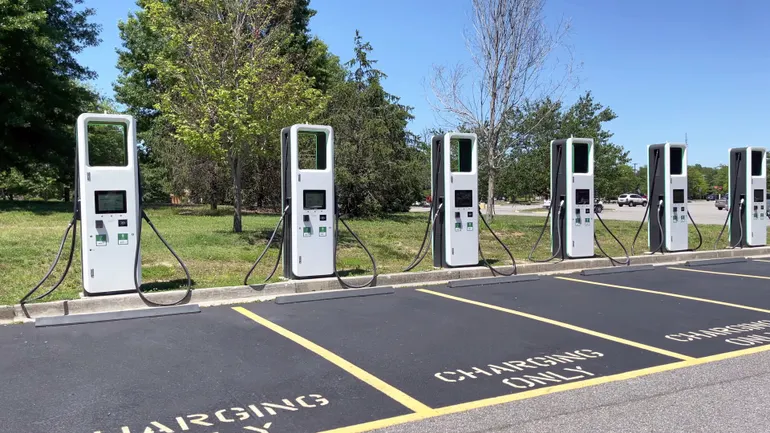
 Image source: DOE (2023), "Charging Station" [jpeg], retrieved fromDOE。
What is a Charging Station?
To meet the federal goal of zero-emission vehicles comprising 50% of new vehicle sales by 2030, the U.S. may need to increase the current number of installed charging stations by nearly 20 times, according to an April 2022 analysis by McKinsey & Company. Utilities such as Consolidated Edison and Arizona Public Service say they are holding off on finalizing charging deployment plans until Treasury guidance is issued.
Kellen Schefter, senior director of transportation electrification at the Edison Electric Institute (EEI), said the Treasury may confirm that investor-owned utilities can "apply the credit to electrical equipment or electric service upgrades" and "install and own" EV chargers and related infrastructure. This construction is supported by the IRA's allowance of a tax credit for each "single item" of charging equipment installed, according to the bill's text. Raising the credit cap to $100,000 "will support the more expensive fast chargers needed for high-demand sites such as commercial fleet parking lots in low-income areas and rural corridors connecting communities," said James Ellis, director of energy and utilities at EV Connect.
But eligibility for the charging station credit depends on wage and apprenticeship requirements that are not yet fully finalized, and low-income areas that are not yet fully defined, he said. He emphasized that the meaning of "single item" must be clarified. Ellis noted that a single item could refer to one charging station or one charging port, and a dual-port charging station (which can charge two vehicles) could have a cap of $100,000 or $200,000, and a tax credit of $30,000 or $60,000. "This is crucial as demand for greater charging capacity grows and more sites adopt a 'convenience store-gas station' model with multiple chargers and ports," he added. "Single item" could also refer to utility system upgrades, equipment to handle the load of new chargers, or site improvements, Ellis and other stakeholders said. EDTA and the Natural Resources Defense Council (NRDC) also raised the "single item" issue in their comments, with EDTA emphasizing that clarifying this definition is essential to avoid deploying outdated technology and to support the installation of solar and bidirectional chargers.
Ellis added that private charger developers and utilities, as well as tax-exempt entities such as rural electric cooperatives, publicly owned utilities, and non-profits, all need this guidance, as these entities can now use the "direct pay option" to build and own charging infrastructure.
What Does "Domestic" Mean?
Christopher A. Smith, Ford's chief government affairs officer, wrote in an IRS comment letter that the U.S. is "at a turning point." Guidance can ensure the U.S. "maintains its position as an economic and technological leader on the global stage" and ensures "the EV revolution is made in America." Most stakeholders agree with this view. Atlas's Nigro said the IRA helps "push the overall U.S. policy toward building an EV industry that does not repeat the mistakes of the fossil fuel vehicle industry or the human rights and environmental abuses of some battery supply chain suppliers."
But RMI acknowledged in its comment to the Treasury that this may be difficult to achieve before automakers "adjust their supply chains and record-keeping" to meet the new domestic content requirements. A comment from Resources for the Future noted that two key challenges are that "only a small fraction of critical minerals" come from the U.S. or free trade agreement countries, and "most battery manufacturing" is located outside North America. NRDC wrote: "The global supply chain of vehicles, parts, batteries, and their minerals is an extremely complex network that no one can currently accurately map."
RMI stated that inclusive definitions of mining, processing, manufacturing, recycling, and value, along with better supply chain tracking, could "improve supply chain transparency." This could also improve "chain-of-custody reporting with end-to-end traceability and foster collaboration across the value chain of suppliers and recyclers," thereby enabling implementation under the IRA's complexity. RMI added that the International Material Data System (IMDS) and the Global Battery Alliance Battery Passport database both offer digital platforms that can track sourcing and provide "clear information for dealers and consumers."
But guidance is still necessary, especially regarding the meaning of "foreign entity of concern," according to comments from BYD Auto, BYD's U.S. subsidiary, and the American Battery Independence coalition. BYD wrote that U.S. subsidiaries "established and operated" under U.S. law, without evidence of "government control by a foreign entity of concern," should not be excluded from tax credit eligibility. Atlas's Nigro said the IRA "aims to build a sustainable domestic supply chain for the EV transition," but Treasury guidance is needed. "When guidance is issued, companies that are ready to comply will be first movers and gain a huge competitive advantage," he added.